
Traditional inspection methods often lead to delays, inconsistent data, and high onboarding time. VISIONSGO streamlines field operations by digitizing workflows, enabling secure data capture, and reducing training requirements. This overview highlights how VISIONSGO improves onboarding, ensures data integrity, enhances security, and delivers real-time insights that drive efficiency and cost savings.

Onboarding is an ongoing activity during turnarounds and day-to-day day inspections. Onboarding efforts include providing training for data collection and date entry, building infrastructure to avoid data breaches (an incident where information is stolen or taken from a system without the knowledge or authorization of the system’s owner), and deliver quality assurance (software product(s) that meet and comply with the organization’s established and standardized quality specifications).
Onboarding efforts for manual workflow processes, can cause delays and cause extended outage periods. Onboarding activities can be highly streamlined and training efforts reduced by 30-50%, when using the VISIONSGO mobility application. Onboarding new inspectors becomes least of a concern because the workflow is digitized, workers are connected via VISIONSGO. Onboarding midstream of a turnaround no longer needs to result in an extension of that turnaround.
Unlike other applications, inspection data captured with VISIONSGO can be directly entered into the Visions Enterprise Asset Performance Management system from the field in real time and the data is retained in its native and usable format eliminating any delays with data capture and data access. (time and delay cost, see operational efficiency)
Third-party companies no longer need access to owner company networks or systems. With VISIONSGO, the contracted third party can establish an account through a digital handshake agreement with the owner company, subsequently receive inspection and maintenance work scopes, and following completion of that work, push the scrutinized data back to the owner company via the cloud. VISIONSGO provides a controlled inspection data collection work environment and without connection to owner company networks.
Data integrity is the maintenance of, and the assurance of, data accuracy and consistency over its entire life-cycle and is a critical aspect to the design, implementation, and usage of any system that stores, processes, or retrieves data, the Single Source of Truth (SSOT).
Best Practices for maintaining data integrity include:
These are inherent in the VISIONSGO Mobility application, data is collected in the same (native) format as your record system is using (exactly the same as the design record X,y,Z-0)
Access to data is tightly regulated to ensure only those with the proper authorizations have access to the data, further, workers only have access to that data that enable them to perform their specific job role.
Maintaining and audit trail, ability to track the source of data changes is vital to know the source of a data breach. An audit trail is generated through an automated process, users of VISIONSGO do not have access to the audit trail.
In the context of VISIONSGO at the workface, observations are high speed and data rich (due to the inherent features of tablet technology eg. Talk-to-text and high-density photos and video) not previously available using traditional field notes.
In the context of traditional pen and paper at the work face, data capture is slow and may only provide sparse data.
Data rich inspection can result in more descriptive inspection reports helping to improve the understanding of equipment condition, and supporting extended inspection intervals and equipment reliability.
Traditional inspection planning, execution and reporting is disrupted when using VISIONSGO. Reporting, which traditionally consumes the majority of the total inspection time and budget is reduced by more than 50 percent. This is a result of the time and cost for reporting evaporates when the data is collected using the preset data fields and formatted inspection templates in VISIONSGO, reporting becomes real-time, not a time-consuming manual process (typically requiring a rework process to correct defective, failed or nonconforming items) deliverable.
Basically, the connected Work can be understood as the connection of frontline workers. The term is primarily used to describe the organizational, process and technological networking of operational, so-called “deskless” employees: Typically employees in production, logistics or other production-related support processes such as inspection and maintenance. Here, the organizational connection comprises the horizontal connection of employees in the production environment as well as the vertical connection to the management level through simplified communication and information supply. The process-related component comprises the bridging of system breaks in the execution of processes – in other words, the elimination of manual data transfers and time-consuming information gathering. The technological solution is the basis for realizing this connection.
The operational efficiency gain presented in the graph below for front-line inspection workers is similar to that of numerous studies that have been completed regarding the connected worker in practice.
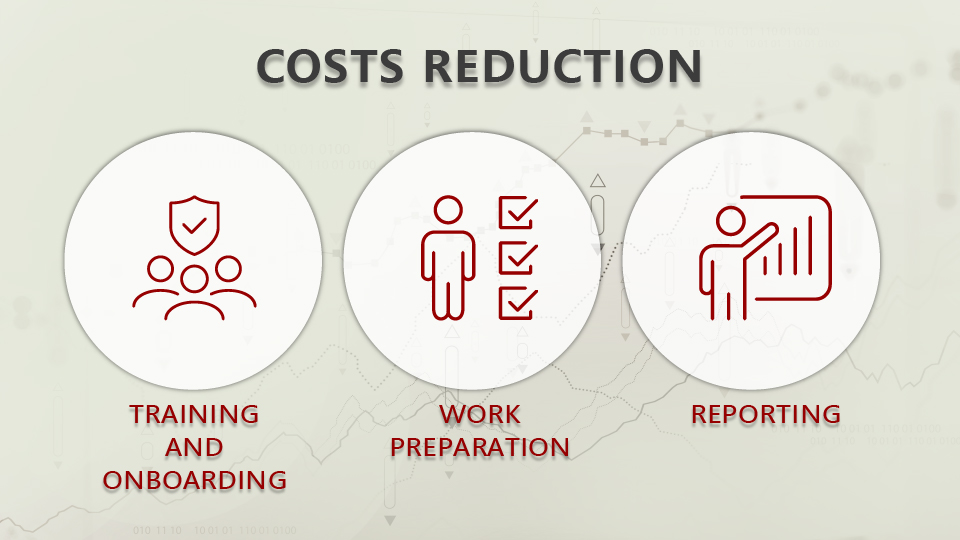
The key success factors for selecting the right technology, for realizing the significant benefits of a connected worker strategy are simplicity and scalability. Simplicity is the key to short onboarding times and thus also to high adoption rates. A reduction of 30-50 percent in training and onboarding are realistic. Scalability is enormously important to leverage the benefits proven in pilots and bring significant added value to your company. These two factors are foundational to the VISIONSGO technology.
Other operational efficiency improvements include:
These do not reflect the more important associated effect on facility uptime (financial savings in the seven to eight-digit range).
Share this on: